


Discussions
Apr 2026
Corporate VC vs. Traditional VC: How Early-Stage Founders Should Actually Think About Their Cap Table

With 4,000 venture funds in the market, founders have more options than ever. That's both a gift and a curse. At Supermoon's Startup x Capital Forum during Digital Asset Summit NY, four investors broke down how to choose wisely.
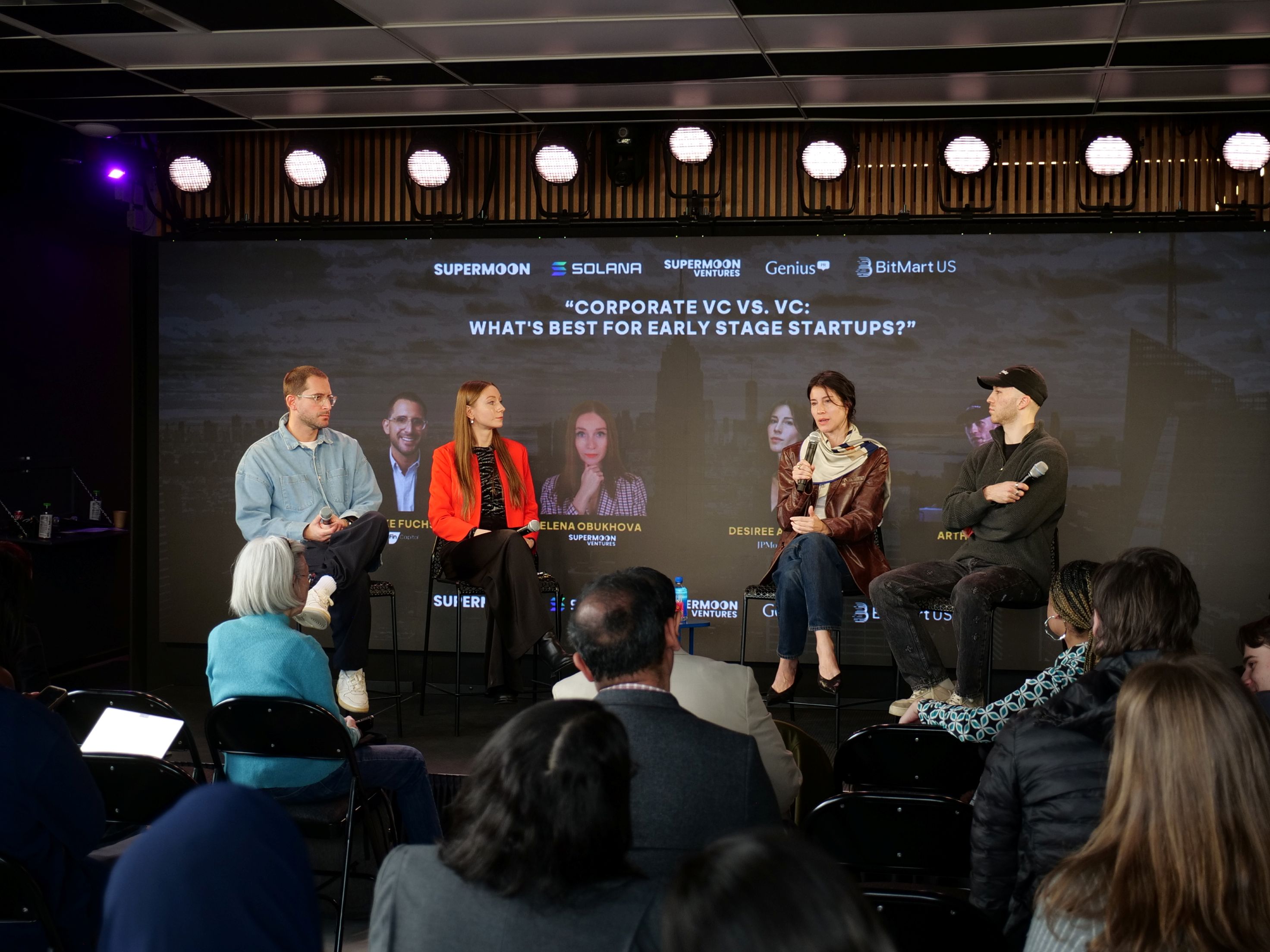
The "Corporate VC vs. VC: What's Best for Early Stage Startups?" panel brought together Jake Fuchs (Principal, Fin Capital), Elena Obukhova (Co-founder, Supermoon), and Desiree Almodovar (VP Innovation Economy, JPMorganChase), moderated by Arthur Firstov (CBO, Mercuryo). The conversation moved quickly past the usual CVC vs. VC talking points and into the decisions that actually shape a startup's trajectory.
Here's what stood out.
It's Not Binary. Stop Treating It Like It Is.
The panel's first and clearest message: the CVC vs. traditional VC question is not an either/or decision. It's a cap table design question.
Desiree Almodovar framed it directly: "I don't think it's very binary. Does having this CVC on your cap table create brand alignment? Can they introduce you to potential customers? Is there a potential exit strategy there? Always just ask a lot of questions rather than just jumping to this black and white, it's good or bad."
Elena Obukhova brought data to the table. Founders backed by CVCs have a higher chance of surviving. Those raising only from traditional investors without any CVC involvement have roughly twice the chance of going bankrupt. At the same time, CVC-backed founders see a 20 to 60% higher probability of getting acquired, and not necessarily by the CVC that led their round.
But Elena was careful to add the other side: "Corporate investors move on different timelines. There are in many cases strings attached. They also historically underperform compared to traditional VCs. They know their vertical, they understand integration, but they are very new to the traditional venture game."
Her recommendation: a CVC may not be the best lead investor on average, but having both corporate and traditional investors on the cap table benefits the founder.
Cap Table Construction Is One of the Most Overlooked Decisions a Founder Makes
Jake Fuchs pushed the conversation toward something more foundational than any single term sheet: the process itself.
"Cap table construction is actually one of the more overlooked aspects of being a founder," Jake said. "I don't think founders run tight enough fundraising processes."
He put the current landscape in context. Fifty years ago, there were maybe 100 to 150 venture funds. Now there are 4,000. That means optionality, but also the risk of spending months chasing the wrong investors.
His advice: do the introspective work before you start fundraising. Figure out what you're optimizing for in this specific round. By the time term sheets arrive, the decision should already be made. "You're not sitting there in the 59th minute trying to figure out which is the better term sheet."
CVCs Move Slower. That's Not Just a Talking Point.
Jake has seen both sides firsthand. At Banktech Ventures, where 110 community and regional banks were LPs, the process involved sourcing companies, introducing them to banks, and having those banks assess the use case. It worked, but it was slow.
At Fin Capital, where the firm also operates an outsourced CVC on behalf of Sumitomo Mitsui (the second-largest bank in Japan), the approach is different. Speed to decision and the ability to form conviction quickly set it apart.
"In this market, things are just moving too quickly," Jake said. "If that's the process you need to run, you're unfortunately going to miss out on good opportunities."
Desiree confirmed this from the JPMorgan side. Having worked at Alley Corp on the VC side and now sitting within a corporate structure, she's seen the contrast up close: "On the VC side, couple decision-makers, things generally moved pretty fast. Where I now sit on the more corporate side, you have a lot more regulatory requirements, a lot more people."
The Incentive Structure Explains Everything
When Elena shared that only about 14 to 15% of corporate VCs perform on par with traditional venture funds, Jake offered a hypothesis that reframed the entire panel.
Most corporate venture arms aren't structured as standalone funds. That changes everything about how they operate. Traditional VCs are judged by their ability to drive returns for LPs. CVCs operating within a corporation are often more motivated to protect against downside than to chase upside.
"It's the classic 'no one gets fired for buying IBM,'" Jake said. "There's likely a bias towards durability that plateaus growth, versus venture, which operates under the power law."
He cited Charlie Munger: "Show me the incentives and I'll show you the outcomes."
Elena added that this difference shows up in what each type of investor prioritizes. Traditional VCs often push for user growth and higher valuations to show returns to their LPs. Corporate investors tend to be more revenue-centric, prioritizing solid use cases they can integrate into their business and introduce to their network.
Build Relationships Before You Need Them, But Build the Right Ones
The panel's closing section centered on how founders should approach relationship-building with both types of investors.
Almodovar's approach was deliberately non-transactional. She talked about inviting people from outside the usual circles to dinners and events, including people from the art world and Broadway, and leading with genuine human connection. "I've found that leading with that, getting to know someone authentically, both is just fulfilling to your life but it ends up coming back to you in a work professional capacity." Her own role at Alley Corp came through someone she knew from the art world.
On the go-to-market side, Desiree was blunt about a pattern she sees too often: "Often the founders that are the most successful are not just the founders sitting making decks about their five different personas. It's the founders that already have those relationships with who they're going to sell to built in from the beginning."
Jake used an analogy that stuck with the room: raising venture capital is like a marriage. Especially at the early stage, you're entering a 10-year-plus relationship with a firm and often with a specific individual.
"If you don't like them as a human, it's not going to work out, I could assure you," he said. "I always insist on what I call the dating process. Let's get to know each other on a personal level. What we like about each other, what we don't, how we would work together."
Elena tied it together: "Find a person who is aligned not only on the business side, but with who you share interests. If you want someone to believe in you, that person needs to have a way to connect with you."
This panel was part of Supermoon's Startup x Capital Forum at Digital Asset Summit NY, a full-day forum for early-stage founders, capital allocators, and institutional players shaping the future of fintech and digital assets.
Related posts
Categories
Helpful Links
Get News and Event Updates Right in Your Mailbox

